Like the Sheikh community, Hanjis are a marginalized ‘service caste’ at the bottom of the Valley’s caste pyramid. Largely confined to the Jhelum River and Dal, Anchar, Manasbal, and Wular Lakes, Hanjis can be divided into several categories on the basis of economic activity:
- Demb Hanz (vegetable growers)
- Gad Hanz (fishermen)
- Gari Hanz (water chestnut gatherers)
- Hak Hanz (gatherers of wood from water bodies)
- Dung Hanz (those who ferry passengers by paddling their boats)
- Shikare Hanz (those who ply Shikara boats)
Interestingly, Hanjis on the Dal Lake live in colonies segregated on the basis of occupation. So, there is a fishermen’s colony, a Shikara-wallahs’ colony, a vegetable growers’ colony, and so on.
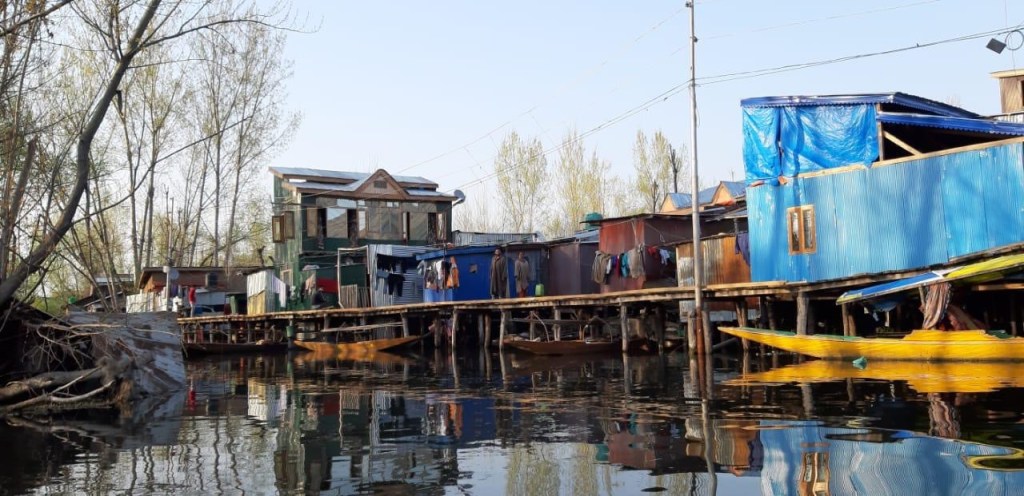
(Above): Fishermen’s Colony on Dal Lake
At the fishermen’s colony – a huddle of tin and tarpaulin hovels – I met Mohd. Shaffi, an interesting case in point of the limited upward mobility the Gad Hanz could acquire through government jobs. He says, “Though I belong to a family of hereditary fishermen, I work as an ASI (Assistant Sub-Inspector of Police) and no longer rely on fishing to earn a livelihood. However a Hanji must always remain a Hanji. I am getting a pucca house constructed, but it still must be located in this nondescript ghetto of fishermen.”
I also met Mohd. Shaffi’s neighbour, 70-year old Haji Ghulam Mohd and his much younger Bengali wife Rasheeda. From Mohd. Shaffi, I learnt that ‘purchasing’ Bengali brides is a common practice among men of the community, especially those disabled, past their prime, or too poor to pay a hefty mehr – a prerequisite for a suitable bride in the Valley.
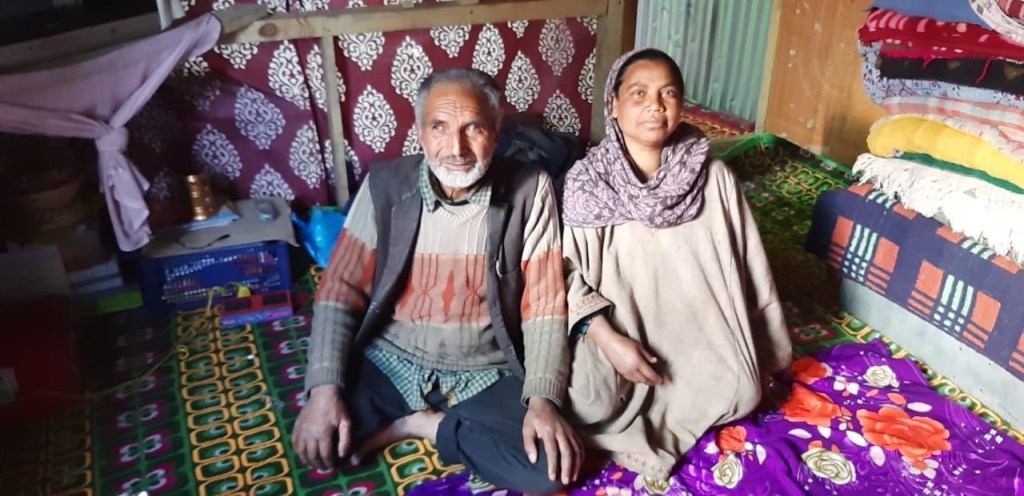
(Above): 70-year-old Haji Ghulam Mohd and his much-younger Bengali wife
Discrimination against Hanjis is largely directed against the poorer communities – the Demb Hanz, Gari Hanz, and most of all, the Gad Hanz. “The Gad Hanz custom of women stepping out of home to sell fish caught by their menfolk was considered an abhorrent practice; a deviation from the norm. The men were regarded as spineless, dependent on women’s earnings” says Dr. Fayyaz Ahmed. In recent years, Hanjis have faced further stigmatization. In 2002, Hanjis came under legal scrutiny when a Public Interest Litigation (PIL) was filed by a local law student over the conservation of Dal Lake. Since then, the High Court has passed several orders to check the lake’s deteriorating condition, and to monitor the lives of Dal residents.
“Overfishing, pollution caused by floating vegetable gardens of the Demb Hanz, and encroachment by Hanjis are widely held as reasons for the Dal’s decline by the government and environmentalists. Though there is some truth to this argument, poor families facing arbitrary evictions and threats to their livelihoods due to anti-encroachment drives are unfortunate. Hanjis have also been known to take care of the lake and indeed, all of Kashmir’s water bodies they call home. Besides, floating vegetable gardens and shikaras – symbols of the Hanji way of life – are an inextricable part of the Dal’s heritage” says Dr. Fayyaz.
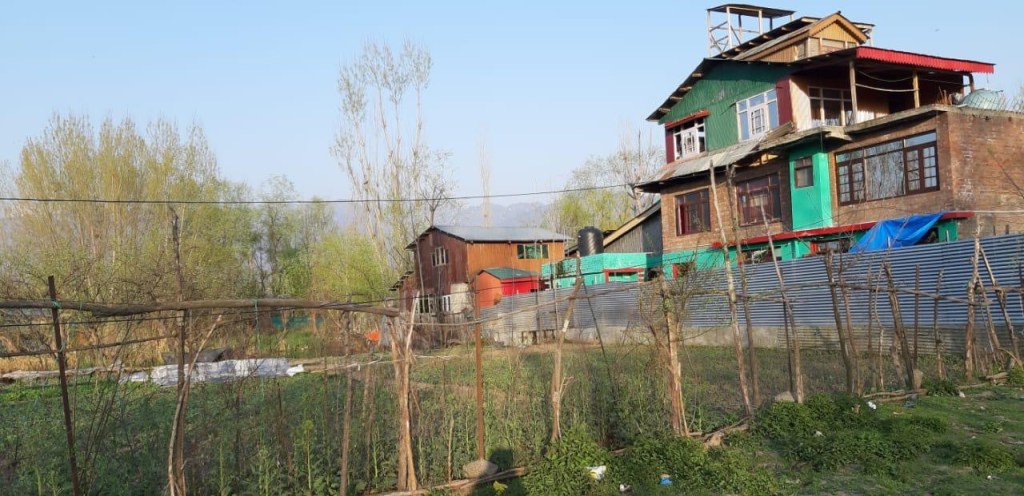
(Above): Demb Hanz Colony on the banks of Dal Lake
Significantly, official narratives avoid mentioning systemic and political factors responsible for the ruin of Dal Lake, namely the city’s unplanned urbanization and increasing militarization, leading to closing of water inflow channels and construction of permanent military bunkers along Dal’s shores. Instead of involving Hanji community members to find solutions, authorities have merely attempted to criminalize them as encroachers. This not only robs them of their material and symbolic identities, but perpetuates their mistreatment as a socially inferior group.
Azaadi & the Revocation of Article 370
For the last three decades, the Kashmir conflict has maintained a vice-like grip over all facets of life. Consequently, the lives of Kashmiris, including Hanjis and Watals, have become entwined with the political turmoil.
For most underprivileged residents of Sheikh mohallas, the anxiety to earn a livelihood outweighed the desire to “fight” for freedom. Lockdowns and curfews were widely pointed as the greatest hurdles to economic betterment and a better future for children. Among the persons I interviewed prior to the scrapping of Article 370, I neither encountered an aspiration for Azaadi, nor unequivocal support for India. Most saw themselves as victims of a bad situation.
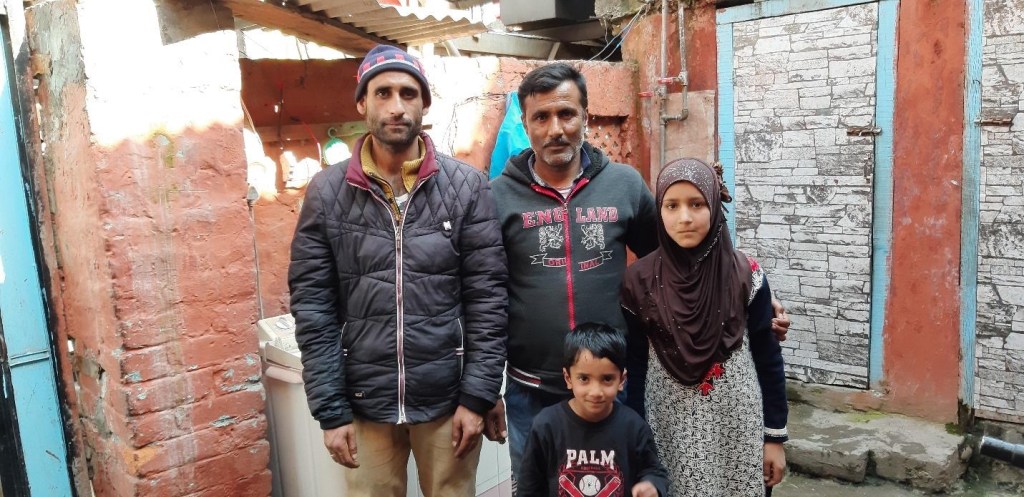
(Above): Shutdowns and curfews curtail the right to earn a livelihood, say daily wage workers Bilal Ahmed Sheikh (left) and Abdul Majid Ghanai (right)
Mohd. Rashid, a resident of Bachi Darwaza said, “Boys of our community don’t engage in stone-pelting. Suppose a boy from our locality is booked on charges of stone-pelting. How will we arrange for bail or fight in the court? We have neither money nor contacts, so they steer clear of such activities.”
Another local resident, requesting anonymity said, “It is common knowledge that the Indian Government wants Kashmir, not Kashmiris. But what have separatist leaders done for us Sheikhs? In fact, Sheikh or not, nearly every poor household will have at least one unmarried daughter because weddings are such an extravagant affair here. But look at Yasin Malik sahib. Instead of marrying a Kashmiri girl, he brings a bride from Pakistan. And one prettier than Karisma Kapoor to boot!”
However, notwithstanding anger and disappointment, there isn’t a total disconnect with the movement. “Kashmir is a conflict zone and involvement in the Azaadi movement is not a facile phenomenon. It’s not black or white” explains Masood Hussain, senior journalist and founder-editor of Kashmir Life magazine. “There are degrees of involvement. For instance, observing a shutdown when a call is given by the separatists and respect for martyred militants may be interpreted as implicit support for the movement. Moreover, when there is a crackdown, the police and army do not spare them either.”
Likewise, Dr. Fayyaz says, “The community is not a homogenous one. There are participants and non-participants. Besides, peer pressure ensures there is a measure of respect for the separatist movement. Indeed, the Sheikh community has produced several well-known militants, Jalaluddin Sheikh and Ramzan Sheikh to name a few.”
Even the Hanjis I met – Shikara-wallahs, fishermen, vegetable growers – did not display passionate support for Azaadi. Like the Watals, they were fed up with frequent disturbances and wanted peace.
For most underprivileged residents of Sheikh mohallas, the anxiety to earn a livelihood outweighed the desire to “fight” for freedom. Lockdowns and curfews were widely pointed as the greatest hurdles to economic betterment and a better future for children. Among the persons I interviewed prior to the scrapping of Article 370, I neither encountered an aspiration for Azaadi, nor unequivocal support for India. Most saw themselves as victims of a bad situation.
Again, Dr. Fayyaz and Masood Hussain bluntly refuted the possibility of total isolation. Like the Watals, the Hanji community had produced famous militants such as Pupa Dar, Jalaluddin Navoo, Bashir Dar, and Zahoor Dar. Dr. Fayyaz says, “The Haritar Tarzoo area of Baramullah is dominated by Hanji fishermen. This area was notorious for militancy until recently. Interestingly, native residents would lend active support to militants, particularly foreign militants. Well-acquainted with the lakes and rivers of the area and adept at rowing boats, these people would help militants escape through water routes.”
However, there seems to have been a shift since the abrogation of Article 370 and bifurcation of the state into two Union Territories (UT) followed by an unprecedented lockdown (which was followed by another interminable COVID-19-induced lockdown). The former ambivalence mixed with a desire for peace has metamorphosed into a deep distrust of the Indian government and a feeling of foreboding with regard to Kashmir’s future.
25-year-old Ayyaz Ahmed Sheikh, son of Yasmin Sheikh whom I had met on my earlier visit, tells me, “I am working as a fruit vendor, I am not sure I’ll ever get a government job. The common perception here is that P.M Modi hates Muslims, hates Kashmiris, his administration is punishing us. People are living in fear of their land and livelihoods being snatched. The sense of impending doom has been exacerbated by the pandemic. With no employment opportunities and an authoritarian, whimsical government, the future appears dark.”
Shams Irfan, Kashmir-based independent journalist, echoes a similar sentiment, “Kashmir is being ruled by the centre. There is hardly any understanding of local issues. Besides, being a government with no accountability, there is no desire to reach out to these marginalized sections or analyse their problems. Their situation is only set to worsen under this regime.”
Significantly, reservation extended to Watals and Hanjis under OSC (Other Social Castes) category has been increased under the UT administration’s new rules.
“Under S.O 127 notified on 20 April 2020, reservation for OSCs in government jobs has been increased from 2 percent to 4 percent. For Economically Weaker Sections (EWS), it is now 10 percent; it was zero percent earlier. Persons from the Sheikh and Hanji community may also avail of this category. These groups are not aware of the rules. The government is doing all it can to uplift underprivileged sections of J&K” says Khurshid Ahmed Sanai (K.A.S), Additional Secretary of the Social Welfare Department.
Ironically, the EWS category may do more harm than help. Dr. Fayyaz says, “With domicile certificates being given to anyone who has resided in the UT for 15 years, the EWS category will throw open the doors to outsiders availing government jobs under this ten percent quota. Since Sheikhs and Hanjis may also avail themselves of this quota, they will face more competition, and tougher times ahead. Moreover, there is a general perception that land prices will skyrocket in the years to come. This may further curtail their limited access to land resources. Future generations of Sheikhs may be rendered homeless.”
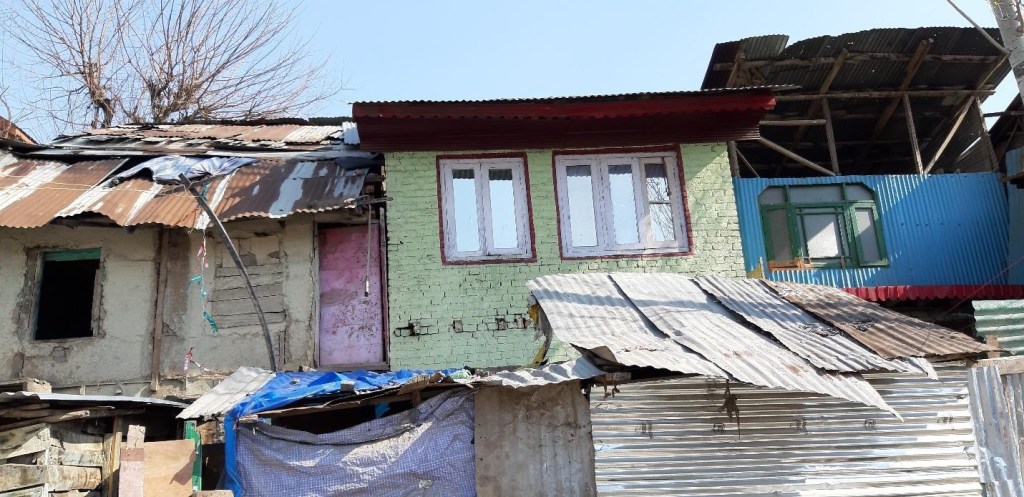
(Above): Cluster of crudely built homes in Bachi Darwaza, Srinagar
Two successive lockdowns lasting more than a year and the resultant economic havoc have plunged Kashmiris into unprecedented hopelessness and despair. In a new Kashmir fraught with collective anxiety over loss of control over land, burgeoning unemployment, and occupation by non-Kashmiris, these subaltern communities are the last priority, leading to their further invisiblization. Abandoned and forgotten by anti-India factions and the Indian government, these peripheral communities are a potent symbol of the deep fault lines in Kashmiri society. That Kashmir’s most revered separatist leaders (who are all at the top of the unsaid caste hierarchy) failed to eliminate these divisions alludes to the exclusionist nature of the Azaadi movement. Simultaneously, their economic plight speaks of the mendacity of successive pro-India governments, and indeed the Indian Government – especially the incumbent one that professes Sabka Saath, Sabka Vikas – itself.
Zahoor Ahmed, a resident of the Demb Hanz colony aptly articulated the unspeakable alienation, disenchantment and world-weary pessimism of Kashmiris in general, and marginalized communities in particular, “Kashmir waise bhi khatam hai. Ab China ke saath jung ho, ya Pakistan ke saath jung ho to hi accha hai. Bomb girayenge, bacha kucha Kashmir bhi khatam kar de to hum Kashmiriyon ki jaan choote.” (Kashmir is doomed anyway. It is better if there is war with China or with Pakistan. Let them drop bombs and finish off Kashmir altogether. That way, we Kashmiris will be spared further horrors.)
Ironically, the EWS category may do more harm than help. Dr. Fayyaz says, “With domicile certificates being given to anyone who has resided in the UT for 15 years, the EWS category will throw open the doors to outsiders availing government jobs under this ten percent quota. Since Sheikhs and Hanjis may also avail themselves of this quota, they will face more competition, and tougher times ahead. Moreover, there is a general perception that land prices will skyrocket in the years to come. This may further curtail their limited access to land resources. Future generations of Sheikhs may be rendered homeless.”
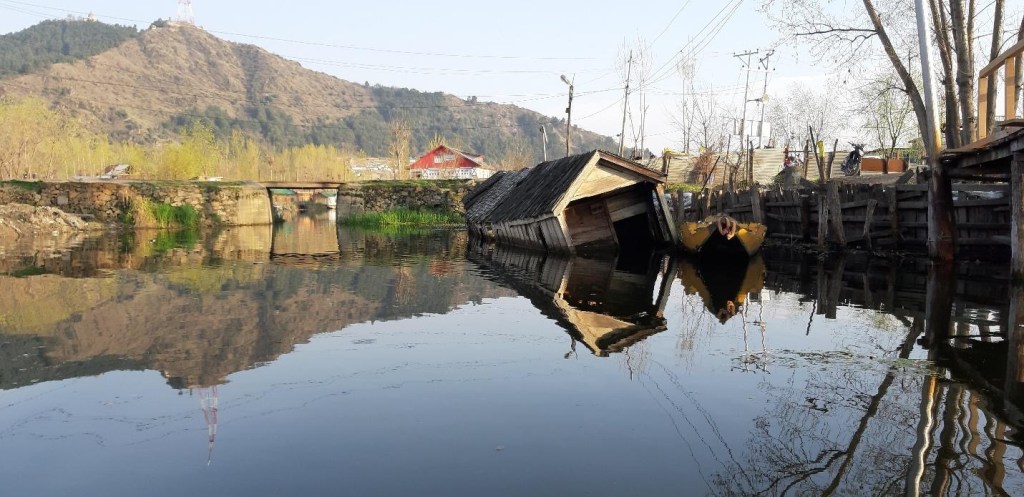
(Above): A sunken houseboat in Dal Lake
This article was written in the autumn of 2020. All interviews and meetings with the persons mentioned took place in April 2019.
 theflaneurdiariescom